Dewan Housing Finance Limited (DHFL)
is issuing Secured Redeemable Non-Convertible Debentures (NCDs) from August 3,
2016.
These NCDs will carry
coupon rates in the range of 8.83% to 9.30%, resulting in an effective yield of
9.20% to 9.30% for the individual investors. Though the issue is scheduled to
close on August 16, but to my view it will get oversubscribed prior to its closing
date.

About DHFL:
Dewan Housing Finance
Corporation Limited, a deposit accepting housing finance company registered
with the NHB and focused on providing financing products for the LMI segment in
India primarily in Tier II and Tier III cities and towns. The Company has been
active in the housing finance sector in India since 1984. It provides secured
finance primarily to individuals, partnership firms and companies for the
purchase, self-construction, improvement and extension of homes, new and resalable
flats, commercial properties and land. It also provides certain categories of
non-housing loans including loans for commercial property, medical equipment,
and for plant and machinery.
Size &
Objective: The Company plans to raise Rs. 4,000 crore from this issue,
including the green shoe option of Rs. 3,000 crore for its lending and
financing activities, to repay interest and principal of its existing
borrowings and other general corporate purposes.
Credit Rating :
CARE and Brickwork Ratings have rated this issue as ‘AAA’ with a ‘Stable’
outlook. Moreover, these NCDs will be ‘Secured’ in nature.
Issue at Floating
Coupon Rate also: The Company is offering Series X NCDs which carries
floating interest rate based on Reference CPI plus applicable spread. The
specified spread shall be 4.18% p.a. for Retail Investors. While the spread
will be fixed throughout the tenor of the Series X NCDs, since the floating
interest rate on such NCDs is total of Reference CPI plus the fixed spread,
floating interest rate will change according to change in Reference CPI. The
floor for floating interest rate has been fixed at 8.90% p.a. and the cap for floating interest rate at
9.50% p.a. For the first year, reference CPI has got calculated at 5.02% p.a.,
so it is 5.02% + 4.18% = 9.20%.
For instance we have 4.52% as the reference CPI for the next
year. In that case, the rate of interest will be (4.52%+4.18%) 8.70% for the
second year subject to minimum 8.90% and maximum 9.50%
Key Points of
Issue:
- Investors will have the option to receive interest on a monthly, annual or cumulative basis.
- Non-Resident Indians (NRIs), foreign nationals and qualified foreign investors (QFIs) among others are not eligible to invest in this issue.
- Minimum investment is for the 10 bonds. Means, you need to invest for a minimum of Rs 10,000. Beyond this you can invest in multiples of 1 bond.
- Allotment will be made on a first come first served (FCFS) basis. Subject to allocation ratio.
Issuance Mode: Available in physical form as well as demat form.
TDS : TDS will be deducted if Interest for a particular financial year exceeds 5000/- however NCDs taken in demat form will not attract any TDS.
Listing, Premature Withdrawal & Put/Call Option: These NCDs will get listed on both the national exchanges i.e. Bombay Stock Exchange (BSE) as well as National Stock Exchange (NSE). The listing will take place within 12 working days after the issue gets closed. Though there is no option of a premature redemption, the investors can always sell these bonds on the exchanges. There is no put/ call option for the NCDs.
Categories of
Investors & Allocation Ratio:
Category
|
Allocation
|
Issue Size (in crores)
|
|
Base Issue
|
Shelf Limit
|
||
Qualified Institutional Bidders
|
20%
|
200
|
800
|
Non-Institutional Investors (NIIs)
|
20%
|
200
|
800
|
High Net Worth Individuals (HNIs) including HUFs
|
30%
|
300
|
1200
|
Resident Indian Individuals including HUFs
|
30%
|
300
|
1200
|
Total
|
100%
|
1000
|
4000
|
Specific Terms for
each series of NCD’s:
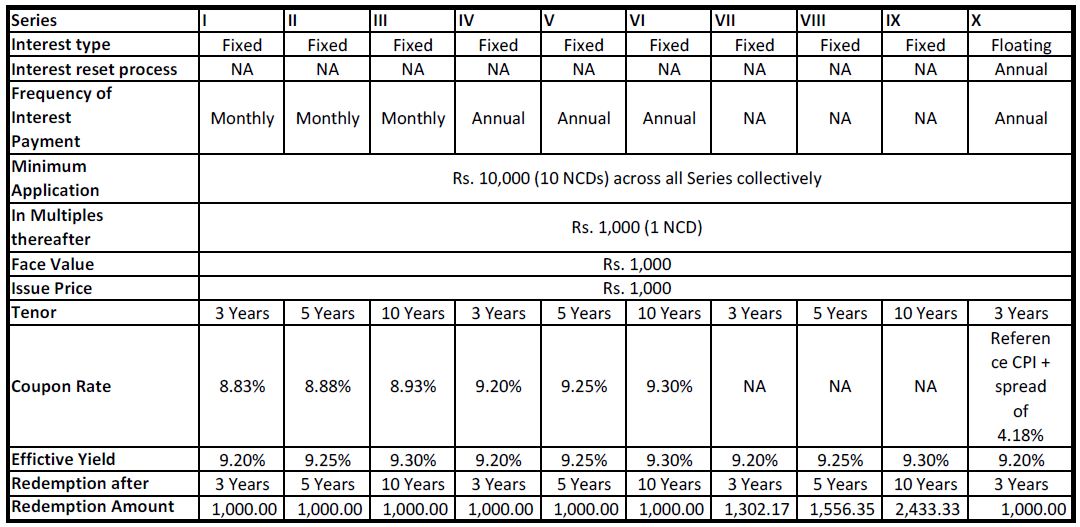
Risk
Factors which you should know before investing:
- Business is particularly vulnerable to volatility in interest rates.
- Any increase in the levels of non-performing assets in its loan portfolio, for any reason whatsoever, would adversely affect its business, results of operations and financial condition.
- Company indebtedness and conditions and restrictions imposed by its financing arrangements could adversely affect its ability to conduct its business and operations.
- In order to sustain its growth, they will need to maintain a minimum capital adequacy ratio. There is no assurance that they will be able to access the capital markets when necessary in order to maintain such a ratio.
- As an HFC, they face the risk of default and non-payment by borrowers. Any such defaults and non-payments would result in write-offs and/or provisions in its financial statements which may have a material adverse effect on its profitability and asset quality.
Should you
invest in DHFL NCDs?
The company is earning good profits consistently in the last
couple of years. This indicates strong repayment capacity of interest from its
profits. As far as coupon rate is concerned, there was a time when debentures
were issued at 14% to 18% coupon rate but in present where risk free return is
around 6% an investor should not expect double digit return from debt
securities. Considering this, these debentures seem attractive. Although it
carries some element of risk, yet they are secured. Considering high interest
rates, secured NCD’s in nature, CPI Linked Interest rates for one of the
options, one can consider investing in these NCD’s after assessing risk factors
indicated above for a tenor of 3 to 5 years.
Investors, who have high degree of confidence in the
execution capabilities of DHFL’s management, can consider investing in these
NCDs for a period greater than 5 years .
Conservative investors should avoid these NCDs and explore
other options like post office saving schemes, tax-free bonds, debt mutual
funds or other listed NCDs.